
Polling is scheduled in all 20 seats of Kerala, 14 of the 28 seats in Karnataka, 13 seats in Rajasthan, eight seats each in Maharashtra and Uttar Pradesh, six seats in Madhya Pradesh, five seats each in Assam and Bihar, three seats each in Chhattisgarh and West Bengal, and one seat each in Manipur, Tripura and Jammu and Kashmir.

We want you to take a selfie with your inked finger and share your experience and learnings with us.
The BJP needs to win at least six of the seats to remain in majority in the 225-member assembly (including the Speaker, who has a casting vote), which would still have two vacant seats -- Maski and R R Nagar.

Most voters have already made up their minds, though the few undecided ones could be critical, feel analysts.

The Odisha government told the assembly over 40,000 workers migrated from the state last year, with the highest number -- 26,151 -- from Balangir.
Thousands of people fled to India to stay away from the polls.
Over 1.57 crore voters were likely to decide the fate of 705 candidates including state Minister Ujjwal Raman Singh, Bharatiya Janata Party state chief Kesri Nath Tripathi and All India Mahila Congress president Reeta Bahuguna Joshi.
Tuesday will not only determine the political fate of India's most populous state, Uttar Pradesh, but will also mark the success or failure of several political bigwigs who led the campaign of their respective political outfits.
Although the high voter turnout in the ongoing panchayat elections in Kashmir is not the end of all its problems, but if followed up with bold political steps and imaginative administrative measures, these elections can provide a platform for what an average Kashmiri needs during the summer of 2011 -- a chance to lead a regular socio-economic life, writes Sushant K Singh.

Phase III of assembly polls in 62 constituencies of West Bengal on Thursday witnessed a series of clashes between political rivals during which bombs were exploded but the violence failed to deter the electors who came out in large numbers, recording a 79.22 per cent voter turnout.

Low voter turnout marked the general elections in Afghanistan on Thursday, as the war-ravaged country voted to choose their next president for the second time since 2001.
There was no move to advance elections to the assembly in Kerala which would be held in the mid-May next year, Chief Election Commissioner S Y Quraishi said on Tuesday.

'If the government can conduct elections during such a time, I am sure they can find ways to bring peace and address the concerns of people. Everything that we had built over the years got burnt and now we are supposed to start our lives from scratch and we should also vote?'

A total 2.51 crore voters are eligible to exercise their franchise for the second phase of elections, including 1.29 crore men and 1.22 crore women.

The final phase saw voting in all 13 seats of Punjab and an equal number of seats in Uttar Pradesh, nine in West Bengal, eight seats each in Bihar and Madhya Pradesh, four in Himachal Pradesh, three in Jharkhand and the lone seat Chandigarh.
Polling across 55 assembly constituencies assembly in nine districts got off to sluggish start at 7 am due to the cold and fog at several places.

He lived in the Pittsburgh suburb of Bethel Park, about 56 km south of the Trump rally site where law enforcement officials said he fired at Trump, the presumptive presidential candidate of the Republican Party.
The Nepal government and political parties should ensure that the long-awaited constituent assembly elections on April 10 are free of violence, candidate intimidation, and efforts to suppress voter turnout, according to the Human Rights Watch. The newly elected lawmakers will draft a brand new constitution and are expected to ratify a pledge by the main political parties to turn Nepal into a federal republic.The Nepali election campaign has been plagued by violence.

Communist Party of India-Marxist and Trinamool Congress workers clashed on Sunday during the fiercely-contested West Bengal civic polls, which recorded a high voter turnout of around 75 per cent. The polls, seen as a semi-final before the 2011 Assembly elections, were held in 81 civic bodies and in the 141-ward Kolkata Municipal Corporation involving an electorate of 85 lakh.
National Conference chief Omar Abdullah has termed the good turnout of voters during the first phase of assembly election as a positive indication towards a better future and stability of Jammu and Kashmir.Huge turnout of voters is an eye-opener and proves that the people of the state want Kashmir issue to be resolved, Omar said while addressing public meetings at Kalakote and Budhal in Rajouri district on Tuesday.
An estimated 53 per cent of the 63.9 lakh voters on Friday exercised their right to franchise in 39 Assembly seats of Naxal-hit Chattisgarh, where polling was held in the first phase, election officials said.While a maximum of 70 per cent turnout was reported in Dhamtari district, 65 per cent of voters cast their ballots in Mahasumund, district electoral officials said.In Maoist-infested Bastar and Dantewara, the turnout was 60 per cent and 45 per cent respectively.
"This farcical election is unacceptable to BNP," Zia told reporters just after midnight and claimed that she had evidence of rampant vote-rigging and that the high figures given by the Election Commission for voter turnout were false
A huge voter turnout of over 80 per cent on Monday marked Bangladesh's first general election in seven years, with Sheikh Hasina and Khaleda Zia appeared locked in a close race to reclaim power. Amid unprecedented security, Bangladeshis gave an overwhelming response to the landmark election, which was largely peaceful, paving the way for the impoverished country's return to democracy following two years of emergency rule.
The 2008 assembly elections in Jammu and Kashmir will be remembered for a host of reasons. Post 1996, it is the first election which has passed off peacefully, without any major untoward incident marring the process. In the wake of the election boycott call given by the separatists, the voter turnout, particularly in the conflict-ridden valley of Kashmir, has been much higher than expected. Many braved the bitter cold and waited for hours outside polling stations.
Against the backdrop of the high voter turnout during the first phase of polling on November 17, election authorities in the state are gearing up by taking slew of measures for successful completion of remaining six phases, which will see 18 more districts going to the hustings.
The 'Pesta Demokrasi' is a cause for celebration not only for Indonesia but also for democracy and forces for peace all over the globe, notes Sandeep Chakravorty, India's Ambassador to Indonesia.
In the coming days, unless Modi tones down the communal spiel, it will be clear that anxiety continues to drive his mind and clouds his judgment, observes Modi biographer Nilanjan Mukhopadhyay.
The phenomenal voter turnout of about 62 per cent in the elections to the 87-member Assembly, held in November-December last year, was a rebuff to the All Parties Hurriyat Conference, a ragtag amalgam of about 40 separatist organisations, which had exhorted people to boycott them.
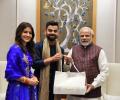
Prime Minister Narendra Modi, on Wednesday, nudged cricketers Mahendra Singh Dhoni, Virat Kohli, among others, to influence their fans and young voters to come out in large numbers and exercise their vote.
A record 74.62 per cent of the 46 lakh voters in Himachal Pradesh on Sunday exercised their franchise in the assembly election where ruling Bharatiya Janata Party and Congress are locked in a virtual straight contest.
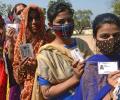
The percentage was 63.14 per cent in Hathras, 61.89 per cent in Firozabad, 63.04 per cent in Kasganj, 65.7 per cent in Etah, 61.51 per cent in Mainpuri, 59.13 per cent in Farrukhabad, 61.93 per cent in Kannauj and 58.35 per cent in Etawah.
Fifty-seven assembly constituencies spread across nine districts went to the polls in this round.
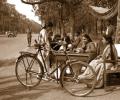
The biggest electoral exercise in the world -- India's general elections -- will be held in seven phases across 543 parliamentary constituencies starting on April 11 till May 19, the Election Commission announced on Sunday. The results will be out on May 23. As India gears up for this massive exercise, here's a throwback to when the nation voted for the first time -- held between October 25 1951 to 21 February 1952.
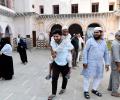
From Instagram to X, social media platforms, in the run-up to the polls have seen bitter poster wars and even bitter meme battles for political one-upmanship.

Israelis began voting on Tuesday in a general election following a high-pitched campaign
The Druk Phuensum Tshogpa, led by former premier Jigmi Thinley, said to be popular among the elite and well educated, on Monday scored a landslide victory in the first elections in Bhutan that marks the end of absolute monarchy in this Himalayan Kingdom. DPT, several of whose candidates have been ministers under King Jigme Khesar Namgyel and have experience in the government, made a virtual clean sweep bagging 44 out of the total 47 seats in the National Assembly.
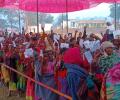
In both of these Hindi heartland states, the straight contest between the ruling Bharatiya Janata Party and the opposition Congress.

'If, as happened in Baramulla during the 2024 Lok Sabha election, the youth in the Valley get triggered enough to jump into the wider fray, the end result would be difficult to predict, especially as the state's post-August 5, 2019 political format remains substantially fragmented and foggy,' points out Mohammad Sayeed Malik, the veteran commentator on Kashmir affairs.

In a remarkable display of resilience and commitment to democracy, the residents of villages that had long been deprived of polling due to terrorist threats and separatist-sponsored boycott calls turned out in large numbers to cast ballots in the sixth phase of Lok Sabha polls on Saturday.
